
logotype
  • Home
    • Main Home
    • Agriculture Corp.
    • Farming Services
    • Agriculture Drones
    • Organic Farm
    • Natural Food

    Main Home

    Agriculture Corp.

    Farming Services

    Agriculture Drones

    Organic Farm

    Natural Food

  • Pages
    • About Us
    • Services
    • Our Team
    • Single Team
    • Philosophy
    • FAQ
    • History
    • Mega Menu Page
    • Typography
    • Elements
    • Page 404
    • Coming Soon
  • Blog
    • Blog Listing
    • Blog Grid
      • 2 columns
      • 2 col + sidebar
      • 3 columns
      • 4 col wide
    • Blog Masonry
      • 2 columns
      • 2 col + sidebar
      • 3 columns
      • 4 col wide
    • Blog Singles
      • Standard
      • Video
      • Quote
      • Gallery
      • Link
      • Audio
    • Single Layouts
      • Overlay Image
      • Image First
      • Title First
  • Portfolio
    • Grid
      • 2 columns
      • 3 columns
      • 4 col wide
      • 5 col wide
    • Masonry
      • Grid 1
      • Grid 2
      • Grid 3
    • Gallery
    • Single
  • Shop
    • Products
    • Cart
    • Checkout
    • My account
    • Wishlist
    Shop
    • Products Grid
    • Single Product
    • Cart
    • Checkout
    • Wishlist
    • Login - Register
    • Help Center
  • Contacts
    Contacts
    We are Here:
    27 Division St, New York, NY 10002, USA
    Send Mail:
    verdaagro@mail.com
    Call Us:
    +1 800 432 45 34
    Instagram
    Twitter
    Facebook
    LinkedIn
    Get in Touch

    Your email address will not be published. Required fields are marked *

    Get in Touch
    logotype
    logotype
    • Home
      • Main Home
      • Agriculture Corp.
      • Farming Services
      • Agriculture Drones
      • Organic Farm
      • Natural Food

      Main Home

      Agriculture Corp.

      Farming Services

      Agriculture Drones

      Organic Farm

      Natural Food

    • Pages
      • About Us
      • Services
      • Our Team
      • Single Team
      • Philosophy
      • FAQ
      • History
      • Mega Menu Page
      • Typography
      • Elements
      • Page 404
      • Coming Soon
    • Blog
      • Blog Listing
      • Blog Grid
        • 2 columns
        • 2 col + sidebar
        • 3 columns
        • 4 col wide
      • Blog Masonry
        • 2 columns
        • 2 col + sidebar
        • 3 columns
        • 4 col wide
      • Blog Singles
        • Standard
        • Video
        • Quote
        • Gallery
        • Link
        • Audio
      • Single Layouts
        • Overlay Image
        • Image First
        • Title First
    • Portfolio
      • Grid
        • 2 columns
        • 3 columns
        • 4 col wide
        • 5 col wide
      • Masonry
        • Grid 1
        • Grid 2
        • Grid 3
      • Gallery
      • Single
    • Shop
      • Products
      • Cart
      • Checkout
      • My account
      • Wishlist
      Shop
      • Products Grid
      • Single Product
      • Cart
      • Checkout
      • Wishlist
      • Login - Register
      • Help Center
    • Contacts
      Contacts
      We are Here:
      27 Division St, New York, NY 10002, USA
      Send Mail:
      verdaagro@mail.com
      Call Us:
      +1 800 432 45 34
      Instagram
      Twitter
      Facebook
      LinkedIn
      Get in Touch

      Your email address will not be published. Required fields are marked *

      Get in Touch
      logotype
      • Home
        • Main Home
        • Agriculture Corp.
        • Farming Services
        • Agriculture Drones
        • Organic Farm
        • Natural Food

        Main Home

        Agriculture Corp.

        Farming Services

        Agriculture Drones

        Organic Farm

        Natural Food

      • Pages
        • About Us
        • Services
        • Our Team
        • Single Team
        • Philosophy
        • FAQ
        • History
        • Mega Menu Page
        • Typography
        • Elements
        • Page 404
        • Coming Soon
      • Blog
        • Blog Listing
        • Blog Grid
          • 2 columns
          • 2 col + sidebar
          • 3 columns
          • 4 col wide
        • Blog Masonry
          • 2 columns
          • 2 col + sidebar
          • 3 columns
          • 4 col wide
        • Blog Singles
          • Standard
          • Video
          • Quote
          • Gallery
          • Link
          • Audio
        • Single Layouts
          • Overlay Image
          • Image First
          • Title First
      • Portfolio
        • Grid
          • 2 columns
          • 3 columns
          • 4 col wide
          • 5 col wide
        • Masonry
          • Grid 1
          • Grid 2
          • Grid 3
        • Gallery
        • Single
      • Shop
        • Products
        • Cart
        • Checkout
        • My account
        • Wishlist
        Shop
        • Products Grid
        • Single Product
        • Cart
        • Checkout
        • Wishlist
        • Login - Register
        • Help Center
      • Contacts
        Contacts
        We are Here:
        27 Division St, New York, NY 10002, USA
        Send Mail:
        verdaagro@mail.com
        Call Us:
        +1 800 432 45 34
        Instagram
        Twitter
        Facebook
        LinkedIn
        Get in Touch

        Your email address will not be published. Required fields are marked *

        Author: Eldon
        HomeEldonPage 6
        light-gfca26acfb_1280
        News
        May 29, 2023by Eldon

        Energy Price Cap Reduction

        Ofgem, the energy regulator, announced a reduction to the Energy Price Cap on Thursday, which is set to see a long-awaited drop in energy bills for millions of households across the UK. The new limit will come into effect from July, to be reviewed every quarter thereafter.

        The Price Cap limits the amount that suppliers can charge for their standard variable tariffs (SVTs), the default deals that individuals are switched to after their fixed or variable tariffs end. In the midst of the energy crisis, most households are now on SVTs, with almost no suppliers currently offering fixed deals.

        As the Cap was forecast to exceed £3,000, the Government introduced the Energy Price Guarantee (EPG) last Autumn. This measure froze the unit cost of gas and electricity so that the average household would pay around £2,500 pa.

        However, the reduction in the Cap means that it is now lower than the Government’s Guarantee, down from £3,280 to £2,074. As a result, the average household will pay roughly 17% less than they are currently paying under the Guarantee.

        For the first time in 18 months, energy prices are beginning to fall for those on SVTs. It is important to note, however, that this isn’t the maximum that you will pay, but the limit on the unit rate that can be charged for the energy you use.

        Return of Fixed Rates?

        Given the reduction in wholesale energy costs, which appear to now be being slowly passed to the consumer, we may see suppliers begin to offer fixed tariffs again. Tying into a fixed deal can be a good way to keep energy bills at an affordable level. However, the risk is that you fix your tariff and then the standard rate decreases, meaning that you are tied in at the higher cost for the remainder of the term.

        If/when fixed deals return to the market, deciding whether to tie in will likely be a gamble, as we don’t know for certain which way prices will go over the coming year. Either way, the latest Cap reduction is a welcome step in the right direction.

        As always, if you have any questions on the above, please feel free to contact a member of the team.

        Read More
        london-g89236bd79_1920
        News
        May 23, 2023by Eldon

        Further Interest Rate Rises

        In an effort to combat high levels of inflation, the Bank of England has increased its base rate further from 4.25% to 4.50% – the 12th consecutive increase. The base rate is now the highest it has been in almost 15 years, since October 2008 which was the height of the global financial crisis.

        The increase is likely to see mortgage and loan repayments rise for those not in fixed term deals. In contrast, it will also mean that you can earn more from savings. Currently, the most competitive rate available on an easy access savings account is around 3.70% gross AER variable. This may rise in the coming weeks following the announcement.

        Under current legislation, basic and higher rate taxpayers have a Personal Savings Allowance (PSA) which is the amount of savings interest that can be earned tax-free. For basic rate taxpayers, the allowance is £1,000 pa, reducing to £500 pa for higher rate taxpayers. Additional rate taxpayers aren’t entitled to a PSA.

        As above, rising interest rates are typically a benefit to savers. However, this could also see some exceed the PSA, giving rise to an income tax liability on the interest in excess of the PSA. Any tax due is typically collected by HMRC automatically, through their pay as you earn (PAYE) system.

        One method to reduce taxable savings interest is to place money into a cash ISA, as any interest earned within this is tax-free. However, contributions are limited to the ISA allowance of £20,000 per tax year, including those made into stocks and shares ISAs.

        Another method is to place money into NS&I (National Savings & Investments) Premium Bonds. These currently have an average prize rate of 3.30% pa gross, and any winnings are received entirely free of income tax. However, as this is the average prize rate, there is no guaranteed rate of return.

        If you have any questions on the above, or would like to discuss anything further, please don’t hesitate to contact a member of our team.

        Read More
        female-g0c46ffa73_1920
        News
        May 2, 2023by Eldon

        Saving during the Cost of Living Crisis

        Having a spending and savings plan can help you understand what income you have, what needs to be allocated to everyday living expenses and what you can put towards future goals. With groceries, fuel and energy costs rising significantly, for many people, essential living costs now represent a large majority of take-home pay.

        The 50-30-20 framework has traditionally been a popular rule of thumb to follow for budgeting outgoings and savings.

        The idea is that you allocate your total income as follows:

        • 50% on current ‘needs’ (essential living expenses): food, transport costs, mortgage/rent, utility bills, essential clothing, minimum repayments on debt balances.
        • 30% on current ‘wants’ (non-essential luxuries): discretionary spending such as gym memberships, eating out, trips, subscription services.
        • 20% towards future savings and debt repayments: putting money aside for unexpected financial emergencies, saving for future goals, investments, pensions, debt overpayments.


        So does the 50-30-20 rule of thumb still apply in the current climate?

        According to budgeting app HyperJar, a new approach of 70-20-10 should be adopted to allow for a much higher proportion of take-home pay to go towards essential purchases, with 20% allocated to non-essential spending and a much lower proportion of 10% towards emergencies and future goals.

        It’s clear that you can’t simply sacrifice spending on essential needs, but it is still important to ensure that you’re optimising what you do spend on these bills, although with things such as utility suppliers, shopping around has become unachievable in the current climate.

        The next step would be to consider wants – are there things you could do without? This could be cancelling subscriptions or deferring spending on luxury items in the short-term. Such changes may not need to be permanent.

        Having the discipline to cut back non-essential expenditure is no easy feat, and it may be tempting to instead reduce outgoings towards future savings and debt repayments.

        Lowering this expenditure can have a significant impact on finances both now and in the future:

        • Cancelling regular savings

        This may seem an obvious option to free up additional cash, but this means you’re likely to miss out on future goals beyond the immediate future.

        • Paying off only minimum balances on debt

        Paying off the minimum payments means you’ll end up paying for in interest payments over the lifetime of your debt. This means less money to spend on the things you enjoy (both now and in the future) as more of it is going on unnecessary interest payments.

        • Reducing pension contributions

        Missing out on the benefits of compound interest/growth can significantly lower your pension savings over the long term.

        • Using your emergency fund to fund other expenditure.

        If something unexpected happens and you don’t have a cushion to fall back on, you may need to resort to credit cards or loans which will ultimately cost you a lot more over the longer-term

        • Cancelling protection policies.

        This is something that’s particularly at risk. Many people don’t see the benefit in paying for protection, as they don’t receive anything tangible for it. However, protection premiums should ideally be grouped in essential expenses. Before taking any action, ask yourself “What would happen if I cancelled this policy and an event occurred that meant I lost earnings/passed away. How would the sum assured be replaced?”

        Ultimately, there’s no one-size-fits-all approach when it comes to budgeting. It all depends on your personal circumstances and financial goals. However, the key to being financially secure starts with being able to understand your spending on needs and how much this leaves for everything else so you can be disciplined in saving for your future goals.

        Read More
        yoga-gf7118147a_1280
        News
        April 17, 2023by Eldon

        Stress Awareness Month

        The month of April is recognised as National Stress Awareness Month to bring attention to the negative impact of stress.

        Given the cost-of-living crisis present in the UK, more people may be feeling the impact of stress and anxiety.

        According to the charity MIND: “Stress is how we react when we feel under pressure or threatened.”

        Not all stress has a negative impact, however. In fact, some research suggests that short-term bouts can help boost the immune system.

        Whilst this is the case, it is important that we manage our mental health and being able to manage stress is an essential component of this. Doing so over the long-term can improve mental and physical well-being, and ultimately help you to become a happier, healthier version of yourself.

        If you are feeling stressed and/or anxious, reaching out to others can be a great start to helping manage this; the knowledge that you are not alone can be a comfort.

        Other ways to manage stress can include:
        • Spending time exercising or exploring nature.
        • Taking up a hobby you enjoy and dedicating time each week to enjoying this.
        • Breathing exercises.

        More useful tips can be found via the links below:
        https://www.nimh.nih.gov/news/media/2021/great-helpful-practices-to-manage-stress-and-anxiety
        https://orwh.od.nih.gov/in-the-spotlight/all-articles/7-steps-manage-stress-and-build-resilience
        https://wellnessatnih.ors.od.nih.gov/Pages/default.aspx
        https://mentalhealth-uk.org/help-and-information/stress/
        https://www.cdc.gov/mentalhealth/stress-coping/care-for-yourself/index.html

        Read More
        piggy-g6539a643a_1280
        News
        March 28, 2023by Eldon

        Get the best out of your Savings

        With rising interest rates, finding a suitable place for your cash savings is increasingly important. There are many things to consider when looking for the best accounts, including the interest rate, accessibility of your cash, and protection limits.

        Interest Rate

        The interest rate is one of the key factors that people focus on when looking for a savings account. With some accounts, you will have the option to receive interest annually or monthly and, usually, the interest rate offered is slightly lower with the monthly option due to the effects of compounding. As such, to maximise your savings interest, it can be beneficial to opt for annual interest, although the monthly alternative can be useful for those that prefer a more regular income stream.

        Currently, a competitive easy-access savings account offers around 3.00% gross Annual Equivalent Rate (AER). This means that on a balance of £10,000, you could receive interest of £300 gross (before tax) over the year.

        Accessibility

        When chasing higher interest rates, it is important to be mindful of the access terms of the account. Accounts can be easy-access, whereby you can make withdrawals without penalty at any time, or they can be fixed, with more limitations.

        A fixed rate account means that the interest rate is guaranteed for the duration of the term, however you are unable to access your cash over the period. These tend to range from 1 year to 5 years. However, there are other options, such as 30-day notice accounts, and those that limit the number of withdrawals, for instance triple-access accounts.

        Protection Limits

        The Financial Services Compensation Scheme (FSCS) means that if a bank or building society fails and can’t pay back your money, you will be entitled to compensation. The bank or building society must be authorised by the Prudential Regulation Authority to qualify. You can check whether an institution is authorised using the Financial Services Register.

        The FSCS will cover up to £85,000 per person, per authorised institution, which means up to £170,000 for joint accounts. However, some banking firms have more than one brand, which means that they share the same banking licence. In this case, the limit applies to the total value of all accounts within the same group, rather than on the holdings with each individual institution.

        Other Things to Consider

        As well as the above, you should also be mindful of the following:

        • Is there a minimum initial deposit required to open the account?
        • Are there any ongoing minimum balance requirements?
        • Do any fees apply?
        • Is the interest rate tiered based on the value of the account?
        • Can the account be opened and managed in branch, by telephone or is it online-only?
        • Does the institution have a good customer service record?

        The rates being offered by banks and building societies can change at short notice and it is best to check the market to see the most competitive accounts available if you’re looking to switch. One way to compare account rates is to use a comparison tool such as MoneySuperMarket. This allows you to filter between different access terms to find a savings account that is right for you. Make sure to set your preference to show all providers, rather than just those that can be opened via MoneySuperMarket.

        It is also important to keep in mind that changing between accounts regularly in pursuit of the highest rates can be a bit of a headache administratively. Sometimes, the additional interest in monetary terms may only be minimal, and not worth the effort of moving funds around.

        If you would like some guidance on whether your money is working in the best way for you, please contact a member of the team.

        Read More
        tandem-g33b46d63f_1920
        News
        March 13, 2023by Eldon

        Eldon Skydives

        On Sunday 4th June, three members of the Eldon team will be completing the highest skydive in the UK. On Monday 5th June, hopefully all three will be returning to work!

        From 15,000 feet, Gemma, Donna and James will each tip out of a small plane and hurtle towards the earth for 60 seconds at 120 mph, before their instructor deploys a parachute. Any higher, and oxygen masks would be needed.

        Donations that the team receive will be directed towards the County Durham Poverty Hurts Appeal. We know that with soaring food prices, energy bills, and other essentials, poverty is painful, and it can affect so many people in our area. We want to make a difference and have discovered the County Durham Community Foundation’s (CDCF) Poverty Hurts Appeal, which will provide funding to groups working with those most affected by poverty in the local area.

        Eldon will be matching funding up to £5,000, and the CDCF will also match contributions. This means that for every £1 given, £3 will arrive with the Poverty Hurts Appeal.

        If you would like any further information on the challenge, and how you can offer support, please consider donating at https://cdcf.enthuse.com/pf/skydive. Donations can also be made via cheque.

        Good luck Gemma, Donna & James!

        Read More
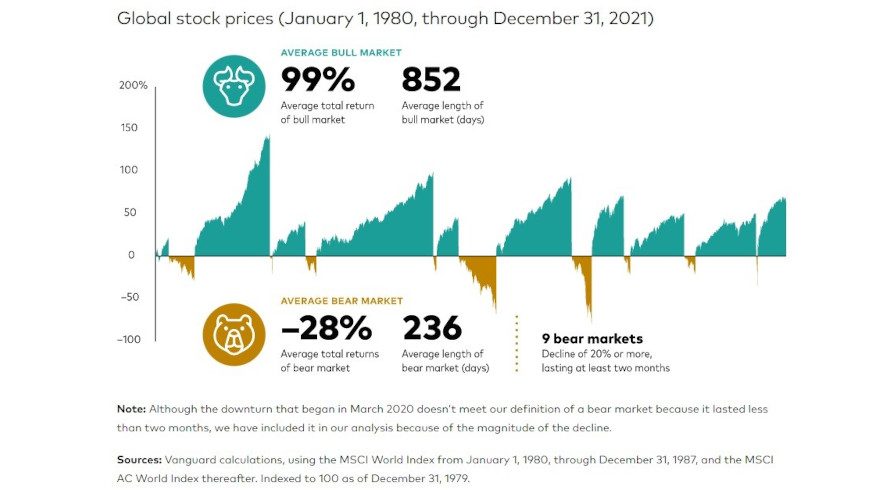
        Bull Bear Markets (002)
        News
        March 6, 2023by Eldon

        Market Performance – 2023 so far

        Looking back to 2022, interest rates started the year at their previous historically low levels, but as inflation was on the rise and the war in Ukraine fuelled these further, central banks around the world increased their base rates. The Bank of England base rate started the year at 0.25% and ended the year at 3.5%. The Federal Reserve’s Federal Funds Rate started at 0% to 0.25% and ended the year at 4.25% to 4.50%.

        Following the rate increases, UK consumer confidence is being recorded at record lows which can often push through into low market confidence. Is this low confidence justified?

        The above chart shows all years from 1980–2021, highlighting the Bull and Bear markets throughout these years. As you can see the total number of Bull years and the average Bull period is far greater than the Bear years. Following each Bear market, we can see the recovery and growth that has occurred. Nothing from 2022 suggests this would be any different, however, that is not to say that we are at the end of the Bear market.

        This also presents an investment opportunity for investors who have capital to place for the medium to long term. Whilst this goes against typical emotional and psychological attitudes, the evidence shows that investing into the market when it is low, typically increases returns as it can benefit from the likely Bull to come without having had the fall from the Bear.

        So how has 2023 started?

        Well, people may have seen headlines that the FTSE100 stock market passed through the 8,000 level for the first time earlier in February. The FTSE All Share is up around 6% since the start of the year and the S&P500 is up 4.2% over the same period. However, inflation looks set to be a key issue again this year.

        The year started positively, with inflation figures coming in below expectations, in both the UK and US. Markets reacted positively to the news, as it was thought, with inflation seemingly coming down, this may result in a lower interest rate rises in 2023, than predicted.

        However, this was short-lived, as inflation data at the end of February in the US has resulted in the biggest weekly loss for 2 months in the S&P500. This has also reaffirmed the Federal Reserve’s previous position – that interest rates will be higher for longer. And now the market seems to be listening to this, with the data now backing-up this statement.

        What this does show, is just how sensitive the market is at present.

        What should investors do? Well, as ever, being disciplined and remaining invested in a well-diversified portfolio will benefit investors and help the longer term trends and returns come through. As we always say, it’s the time spent ‘in the market’, rather than trying to ‘time the market’ that counts.

        Read More
        State Pension
        News
        February 15, 2023by Eldon

        Check your State Pension

        The State Pension age is the earliest you can claim your State Pension. Your State Pension age depends on when you were born. For people reaching State Pension age now, it is age 66 for women and men, but the Government has set out two increases to State Pension age in legislation.

        For those born after 5 April 1960, there will be a phased increase in State Pension age to 67, and eventually to age 68. You can check your State Pension age here: https://www.gov.uk/state-pension-age

        In most cases, you can get a full State Pension if you have 35 qualifying years of National Insurance contributions. You need a minimum of 10 qualifying years to receive any State Pension entitlement.

        The full State Pension is currently £185.15 per week increasing by 10.1% to £203.85 per week from April 2023. For some, this may differ due to the way the rules in place pre-2016.

        You can check your current State Pension entitlement either by submitting a BR19 Form to the Department for Work & Pensions or by logging onto the Government Gateway.

        If you find yourself with a lower amount than £185.15 per week you may be able to improve your record either through accruing further qualifying years up until State Pension Age or by making Voluntary National Insurance contributions to plug any gaps in your National Insurance record.

        Currently, you have up until 5th April 2023 to fund any gaps in your record between April 2006 and April 2016. After this, you can only fund gaps going back 6 years. Therefore, if you are close to State Pension Age and are not entitled to the full State Pension as things stand, it will be wise to check for any gaps in your National Insurance Record between 2006 and 2016.

        If you are thinking about topping up your State Pension for these earlier years, you should check with the Future Pension Centre at the Department for Work and Pensions (DWP) if purchasing those years would improve your State Pension entitlement. They can also advise which years will be most cost effective for you to purchase to improve your State Pension.

        Buying any missed years (if you have any that would count) comes at a cost. This can be achieved by:

        • paying Voluntary Class 3 NI contributions at current cost of £15.85 per week in 2022/23 (increasing to £17.45 per week in 2023/34)
        • paying Voluntary Class 2 NI contributions of £3.15 per week (£3.45 per week in 2023/24), if you are Self Employed and your profit is below £6,725 per annum


        If you have some way before reaching State Pension Age, it is important to note that you can accrue qualifying years through the following means and you therefore may not need to fund any gaps in your record:

        • earning enough to pay NI contributions on a Self Employed basis (currently £6,725 pa)
        • earning over £123 a week from one employer on an employed basis
        • gaining a credit for example by being in receipt of Job Seekers Allowance or Carers Allowance
        • caring for a child / grandchild under the age of 12, while (the parent is) claiming Child Benefit


        Useful Numbers and websites:

        Pension Service – 0800 731 7898

        HMRC National Insurance Service – 0300 200 3500

        Read More
        diary-g3d37f22ab_1920
        News
        January 31, 2023by Eldon

        Key Dates for 2023

        In the last article, we looked at the looming January Self Assessment deadline. There is no shortage of important dates to be aware of when considering your finances; below, we have outlined the key dates to note for the coming year.

        • 31st January – Self Assessment Tax Return Deadline

        This is the deadline for those who need to file a Self Assessment tax return for 2021/22, and is the date that any tax owed must be paid by. If applicable, the first payment on account for 2022/23 must also be made by this date.

        • 5th March – Rail Fares Rise

        The Government has frozen rail fares until 5th March, on which date they are set to rise by a maximum of 5.9%. A cap has been imposed to help with the cost of living.

        • 15th March – The Budget

        March typically sees the Chancellor’s main Budget of the year, in which they outline the financial forecasts for the year and any proposals for tax changes. This year’s budget is expected to be held on 15th March.

        • 31st March – End of Help to Buy Scheme

        The Help to Buy Scheme was offered by the Government to help first time buyers, but closed in October 2022. Those already buying under the scheme have until 6pm on 31st March to complete on their purchase.

        • 1st April – Energy Price Guarantee Rises; Changes to Household Bills; and Wage Rises

        The Government’s Energy Price Guarantee, which has frozen the unit cost of gas and electric, will rise on 1st April. As a result, the average household will pay around £3,000 pa for energy, up from £2,500 pa.

        Other household bills are also set to rise from the start of April, including broadband, council tax and water. Whilst the increases aren’t known yet, they will likely account for inflation to some extent. However, some households may see their water bills fall based on certain providers being unable to meet Ofwat targets on pollution and other issues.

        In addition, the National Living and National Minimum Wages are increasing from this date.

        • 5th April – Voluntary National Insurance Contribution Deadline

        For those looking to top up their State Pension entitlement by making voluntary National Insurance (NI) Contributions for any gaps in their NI Record between April 2006 and 2016, the deadline is 5th April. Following this, individuals will typically only be able to make contributions for the previous six tax years.

        • 5th April – End of the Tax Year

        The current tax year (2022/23) will end on 5th April. If you’re planning to make use of tax allowances for the year, you will need to do so before this date.

        • 6th April – New Tax Year

        The new tax year (2023/24) starts on 6th April, from which point tax allowances ‘refresh’. State benefits and other Defined Benefit pension income will also increase from this point, with the State Pension and Pension Credit both rising by 10.1%.

        Certain tax changes announced in the Autumn Budget are also set to come into effect. The additional rate income tax threshold, above which income tax is due at 45%, will reduce from £150,000 to £125,140. The dividend tax-free allowance will also fall from £2,000 pa to £1,000 pa.

        Similarly, the capital gains tax exemption will reduce from £12,300 pa to £6,000 pa.

        • 31st July – Second Payment on Account

        For those in Self Assessment, the second payment on account for 2022/23 must be made by 31st July.

        • 5th October – Deadline to Register for Self Assessment

        This is the deadline anyone new to Self Assessment has to register by.

        • 18th October – September Inflation Announcement

        Inflation figures announced in September are used when calculating changes to State Benefits, tax credits, the increase to the State Pension, and increases for many Defined Benefit pensions. Such changes usually come into effect at the start of the following tax year.

        • 31st October – Postal Self Assessment Deadline

        Those opting to file their Self Assessment tax return for 2021/22 by post, rather than online, will need to so by 31st October.

        • November – Autumn Statement

        The Chancellor’s Autumn Statement, typically a ‘mini Budget’, is usually delivered in November each year. The purpose is to provide an update on the Government’s economic plans based on the latest forecasts from the Office for Budget Responsibility (OBR).

        • 31st December – End of Mortgage Guarantee Scheme

        The Government’s Mortgage Guarantee Scheme was launched in April 2021, offering lenders the option to purchase a guarantee on mortgages where borrowers have a deposit of only 5%. The scheme is designed to help more households get onto the property ladder. Originally ending in 2022, the scheme has been extended until 31st December 2023.

        If you would like to discuss any of the above with a member of the team, please don’t hesitate to contact us.

        Read More
        deadline-gc3a95f473_1280
        News
        January 16, 2023by Eldon

        Deadline for Self Assessment is Approaching

        The 31st January 2023 deadline for submitting Self Assessment tax returns for the 2021/22 tax year is fast approaching. For those who need to submit a return it is important to do so before this deadline so as to avoid late filing penalties.

        If you are unsure whether you need to complete a tax return for the period above, you can check your position using the government tool.

        If you miss the deadline for submitting your tax return, you will typically be charged a penalty of £100 if the tax return is up to 3 months late. If you submit your return over 3 months late, you may be faced with a larger penalty.

        For the last two years, HMRC has waived the £100 late filing penalty in light of the pandemic, but no waivers for late submissions have been announced this year.

        Any tax due must also be paid and received by HMRC on 31st January 2023. HMRC will charge interest on any late payments of tax:

        • If your tax payment is up to 30 days late, you may be charged a penalty of 5% of the tax due.
        • You may also be charged with further 5% penalties when your payment is 6 months and 12 months late.

        You can complete your Self Assessment tax return online here.

        You can pay your outstanding Self Assessment tax bill online using this link.

        For a fee, professional accountants can help you complete your Self Assessment, or complete it on your behalf, however they will require the figures to input. Please let us know if you would like recommendations of accountants we have experience working with.

        Read More
        • 1
        • …
        • 4
        • 5
        • 6
        • 7
        • 8

        VerdaAgro

        Driven by passion. Grounded in purpose. Focused on results.

        verda@mail.com
        +1 800 123 46 57
        Instagram
        Twitter
        Facebook
        LinkedIn

        Useful Links

        • Company
        • Services
        • Features
        • FAQs
        • Getting Started

        Subscribe

          Our expertise, as well as our passion for web design, sets us apart from other agencies.

          © 2025 VerdaAgro byWebGeniusLab. All Rights Reserved